Development partner for high-tech mechatronic systems! Contact Us

Control Techniques
Future machines need control systems that are accurate, robust and practical to maintain. INGENIQS has the knowledge and experience of both conventional and advanced control technologies, from proven PID control to model-based and learning control techniques.
PID control
PID control is typically used for single-input single-output motion, temperature, pressure or flow loops. By tuning in the frequency domain, we shape bandwidth and stability margins. The advantage is robustness, simplicity and easy industrial implementation. A limitation of PID control is that it is purely feedback-based: the controller only reacts after an error or disturbance has already occurred. In addition, tuning is limited to proportional, integral and derivative action, which can restrict achievable performance, especially when utilizing advanced control techniques.


Feedforward
Feedforward control is used when disturbances or system behavior can be predicted or modeled in advance. Instead of waiting for an error to occur, the controller proactively compensates before the disturbance affects the system. This improves tracking performance and lowers the burden on the feedback controller. The effectiveness of feedforward strongly depends on the accuracy of the underlying model or prediction. Incorrect models or unmeasured disturbances can limit the achievable improvement.
MIMO
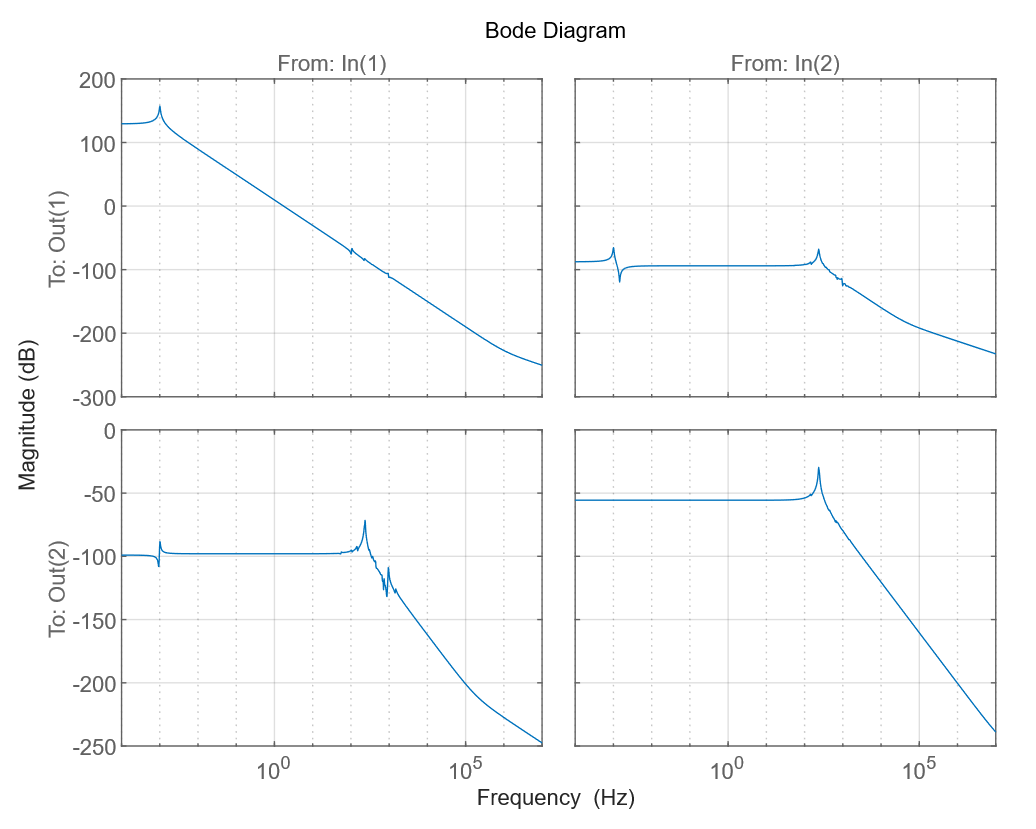
Multi-Input Multi-Output control is used when several actuators and sensors interact strongly. It handles coupling directly by considering interaction between all inputs and outputs and defining their effect on the overal robustness and performance of the system. By defining these interactions, full system stability can be guaranteed, whereas this does not hold when tuning each loop from single actuator to single single sensor only.
Model Predictive Control
MPC is typically used when constraints, multiple variables or future trajectory information matter. It predicts system behavior and optimizes the control action over a time horizon. Its strengths are constraint handling, performance optimization and coordination between inputs. Its performance is constrained by the model quality. Insufficiently advanced models lead to poor results, while high-performing models require substantial computational power and hardware resources. MPC is very suited to optimize throughput, energy consumption or others process variables, supported by our expert services.
Model Based Adaptive FF
Model-based adaptive feedforward is used when machine behavior changes with load, temperature, wear or operating point. The control action is based on first-principles system models and continuously adapts to the current machine behavior. This enables high performance over a wide operating range while maintaining physical interpretability of the model. The main challenge is that accurate modeling and a stable and converging adaptive algorithm design require deep system understanding and careful controller design.


PGNN feedforward
Physics-Guided Neural Network feedforward is used when first-principles models are available but do not capture all real-world effects. It combines physics insight with data-driven learning. By using this structure, the physical models remain simple while being able to predict and compensate for complex or highly dynamic system behavior achieved by adding the neural network. This can deliver high accuracy while staying more interpretable than a purely black-box model, such as a pure neural network. The challenge is that it needs representative data and careful validation.
Iterative Learning Control
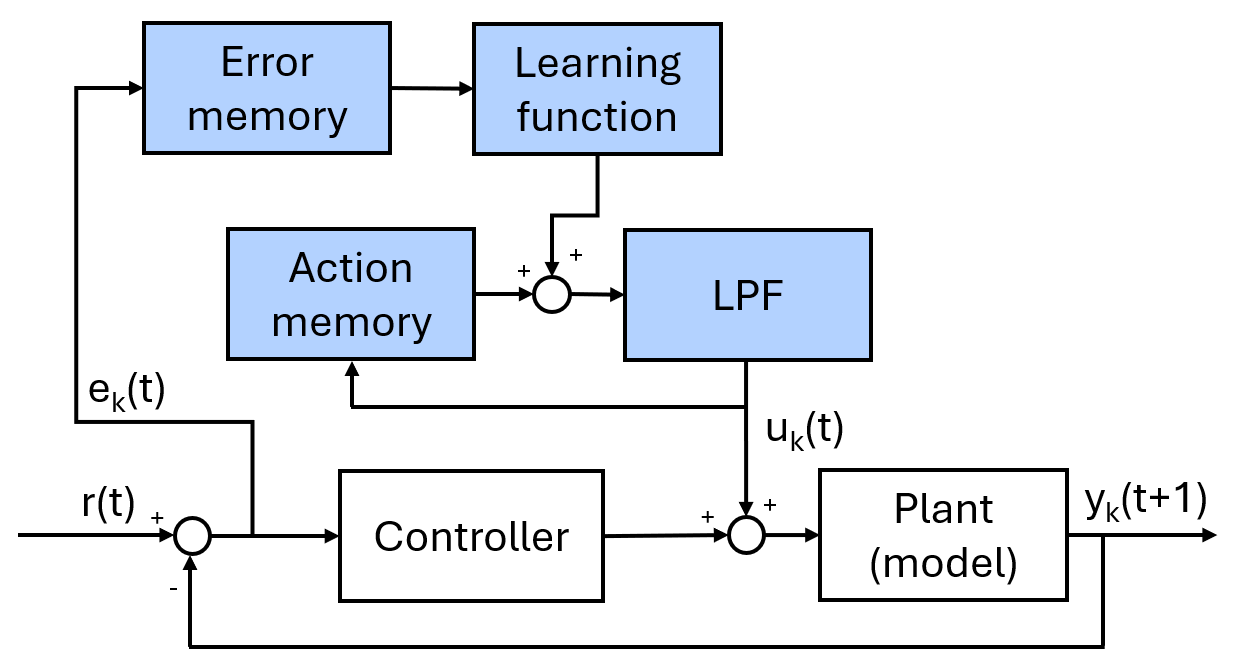
ILC is used for repetitive processes, such as scanning, pick-and-place or cyclic motion. It learns from previous runs and improves the next one by processing the error and updating the feedforward signal. The advantage is excellent tracking performance for repeated tasks. More sophisticated techniques even allow to deploy ILC to varying tasks by parameterization of the signals. The limitation is that it is less suitable for systems which suffer from non-repetitive disturbances or highly variable processes.